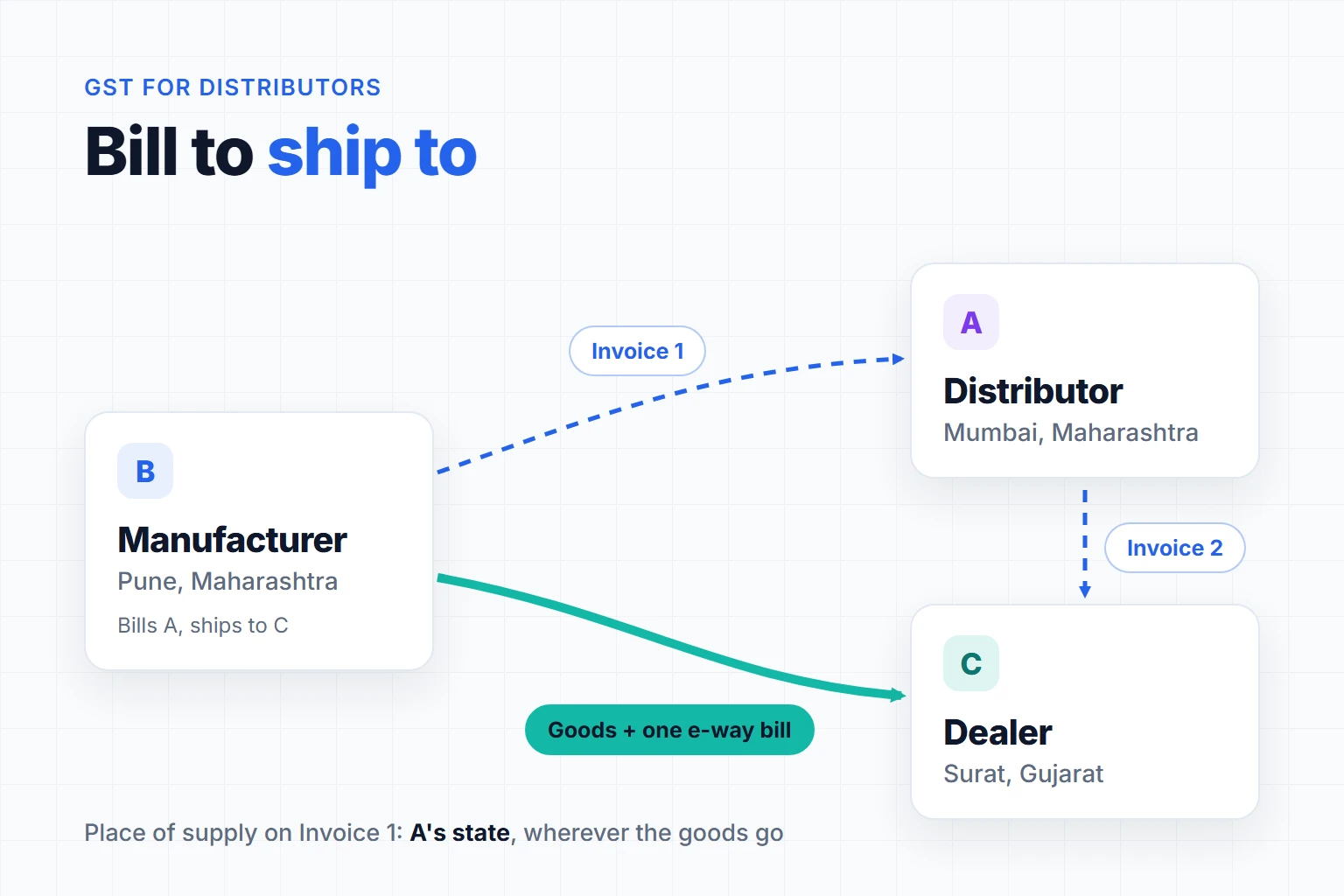
Bill to ship to in GST is a sale where the business you bill isn't the place the goods go. It's everyday work in dealer networks: a distributor in Mumbai orders 200 cartons from you and asks you to deliver them straight to its dealer in Surat. GST treats that as two sales, with two tax invoices and one e-way bill. The place of supply on your invoice follows the distributor, not the truck.
In short:
- Two invoices: the supplier bills the buyer and the buyer bills the party that receives the goods.
- Place of supply on the first invoice: the buyer's state, wherever the goods are delivered.
- One e-way bill: generated by either the supplier or the buyer, never both.
- Input tax credit: the buyer can claim it even though the goods never reach its premises.
- Ship-to GSTIN: a rule to make it mandatory from 1 August 2026 was put on hold on 29 July 2026.
What bill to ship to means: the three parties
The Ministry of Finance's April 2018 clarification names the three parties A, B and C. This guide uses the same letters.
| Party | Role in the sale | Usually, in a dealer network |
|---|---|---|
| A | Orders the goods and asks for them to go to someone else | The distributor or super stockist |
| B | Sends the goods directly to C on A's behalf | The manufacturer or a larger distributor |
| C | Receives the goods | A's dealer or retailer |
The same pattern turns up in other forms: a brand that bills its C&F agent but ships to a modern trade store, a distributor that buys for a dealer's new outlet in another town or a company billed at head office with goods sent to a project site.
Two sales and two invoices
The goods move once (from B to C) but they're sold twice. The 2018 clarification says two supplies are involved and so two tax invoices are needed:
| Invoice | Issued by | Issued to | What it covers |
|---|---|---|---|
| Invoice 1 | B | A | B's sale to A, with C's address as the delivery address |
| Invoice 2 | A | C | A's sale to C |
Each one is a normal tax invoice with every field Rule 46 asks for. Our GST invoice format lists them. Invoice 1 is the one that's different, because the goods go somewhere other than the buyer's address.
Place of supply in bill to ship to
For goods that move, the place of supply is normally where the movement ends. Bill to ship to is the exception. Section 10(1)(b) of the IGST Act says that when goods are delivered to someone on the direction of a third person, that third person is deemed to have received them. The place of supply is then the third person's principal place of business.
So for Invoice 1, the place of supply is A's state. For Invoice 2, the normal rule applies and it's where the goods are delivered to C. Compare that state with the supplier's state on each invoice and you have the tax:
| B (supplier) | A (buyer) | C (delivery) | Invoice 1, B to A | Invoice 2, A to C |
|---|---|---|---|---|
| Pune, MH | Mumbai, MH | Surat, GJ | CGST and SGST, though the goods go to Gujarat | IGST |
| Pune, MH | Indore, MP | Nagpur, MH | IGST, though the goods stay in Maharashtra | IGST |
| Pune, MH | Indore, MP | Bhopal, MP | IGST | CGST and SGST |
| Pune, MH | Mumbai, MH | Thane, MH | CGST and SGST | CGST and SGST |
The second row catches people out. The truck never leaves Maharashtra. Both invoices still carry IGST: B sells to a buyer whose place of business is in Madhya Pradesh. A, registered in Madhya Pradesh, then sells goods delivered in Maharashtra.
If C isn't registered, Invoice 2 follows clause (ca) of the same section: the place of supply is the address recorded on the invoice for C. Record C's address (or at least its state). Without it, the place of supply becomes A's own location.
Bill to ship to invoice format
Rule 46 of the CGST Rules asks for the "address of delivery where the same is different from the place of supply". On Invoice 1 it always is. So Invoice 1 shows two parties:
- Bill to: A's name, address and GSTIN, with A's state and its code as the place of supply.
- Ship to: C's name and delivery address, with the state and its code. Add C's GSTIN if it's registered. It isn't required today but it helps everyone downstream match the paperwork.
Invoice 2 is a plain invoice from A to C, with C as the buyer and C's state as the place of supply. A doesn't send the goods. It still issues the invoice, reports the sale in GSTR-1 and pays the tax.
Our free GST Invoice Generator asks for the place of supply separately from the buyer's state. Set it to A's state on Invoice 1 and it splits the tax into CGST and SGST or IGST correctly.
Input tax credit in bill to ship to
A pays B's tax on Invoice 1 but never sees the goods. Can A claim the credit? Yes. Section 16(2)(b) of the CGST Act only allows credit on goods received. Its explanation deems the registered person to have received the goods "where the goods are delivered by the supplier to a recipient or any other person on the direction of such registered person".
So the credit follows the invoices:
- A claims credit on Invoice 1 from B, once it shows in A's GSTR-2B and the other usual conditions are met.
- C, if registered, claims credit on Invoice 2 from A. C never gets a claim on Invoice 1, because B didn't sell to C.
- B claims credit on its own purchases as usual.
Because the deemed receipt rests on A's direction to B, keep that direction on record (A's purchase order with C's delivery address on it) and keep C's signed proof of delivery. If A's credit is ever questioned, those two documents show the goods were delivered where A asked. Our guide to proof of delivery in B2B covers what a good delivery record holds.
Bill to ship to e-way bill
If the consignment is worth more than ₹50,000, Rule 138 needs an e-way bill before the goods move. Some states set their own limit for movement within the state. Check yours. A bill to ship to sale has one movement and needs one e-way bill. The 2018 clarification says either A or B can generate it. It also sets out what goes in Part A:
| Part A field | If B generates it | If A generates it |
|---|---|---|
| Bill from | B | A |
| Dispatch from | B's place the goods leave from | B's place the goods leave from |
| Bill to | A | C |
| Ship to | C's address | C's address |
| Invoice | Invoice 1 | Invoice 2 |
In practice B usually generates it, because B loads the truck and already has Invoice 1. Agree who does it when the order is placed. If both do, there are two e-way bills for one truck. If neither does, the goods move without one. Our guide to GST-ready dealer order management covers making the e-way bill part of the order workflow so it can't be skipped.
Which transaction type to pick
The e-way bill has four transaction types: Regular, Bill To Ship To, Bill From Dispatch From and a combination of the last two. Going by the fields above:
- When B generates it, the bill-to party (A) and the ship-to party (C) differ. That makes it Bill To Ship To. The e-way bill API rules put A's GSTIN, name and state in the "to" fields and C's address, PIN code and state in the delivery fields.
- When A generates it, C is both bill-to and ship-to. The goods leave from B's premises, not A's, which makes it Bill From Dispatch From, with B's address as the dispatch place.
The e-way bill's validity depends on the distance, which runs from B's dispatch point to C's PIN code. Enter A's PIN code by mistake and the validity is worked out for the wrong trip.
E-invoice ship-to details
If you have to e-invoice, Invoice 1 goes to the invoice registration portal with a ship-to block. In the IRP's e-invoice schema, filling in ShipDtls is what marks the invoice as bill to ship to. Filling in DispDtls as well makes it the combination type.
| Field in ShipDtls | Required? | What goes in it for Invoice 1 |
|---|---|---|
| Gstin | No | C's GSTIN (or "URP" if C isn't registered) |
| LglNm | Yes | C's legal name |
| Addr1 | Yes | C's delivery address |
| Loc | Yes | C's town or city |
| Pin | Yes | C's PIN code |
| Stcd | Yes | C's state code |
The place of supply sits in the buyer block (Pos). For Invoice 1 it's A's state code. If you generate the e-way bill together with the IRN, the ship-to PIN code is the one the e-way bill uses. Leave out the ship-to block and the system falls back to the buyer's PIN code, which for a bill to ship to sale is the wrong place.
If A has to e-invoice too, its Invoice 2 has C as the buyer and B's premises as the dispatch place (DispDtls).
When it isn't bill to ship to
Not every delivery to another address is a bill to ship to sale. If the goods go to another godown or shop of the buyer under the buyer's own GSTIN, there's only one sale. Bill the buyer, show the other address as the delivery address and generate a regular e-way bill.
Bill to ship to needs a third party: someone other than the buyer who receives the goods on the buyer's direction.
The Ship-to GSTIN rule is on hold
In June 2026, GSTN issued advisories (dated 9 and 17 June) on e-way bill changes due from 1 August 2026, followed by FAQs on 2 July. The main change was to make the ship-to party's GSTIN a mandatory field in Bill To Ship To and combination e-way bills, with "URP" for a recipient that isn't registered.
On 29 July 2026, GSTN put the changes on hold "until further notice". It told taxpayers that no production changes are needed under those advisories and said the advisories and FAQs would be withdrawn from the portal. As of 23 October 2026, GSTN hasn't announced a new date.
So nothing changes today: the ship-to GSTIN isn't required on e-way bills and stays optional on e-invoices. Two things are still worth doing, because they cost little and they're what the rule would ask for if it comes back:
- Keep the GSTIN of every dealer you ship to on file, not just the GSTIN of the party you bill. Mark the ones that aren't registered.
- Check the ship-to GSTIN differs from the bill-to GSTIN. If they match, it's a regular sale to the buyer's own address, as in the section above.
We'll update this guide when GSTN announces a new date.
Common bill to ship to mistakes
- IGST on Invoice 1 because the goods crossed a state border. The place of supply is A's state. If A and B are in the same state, Invoice 1 carries CGST and SGST.
- No delivery address on Invoice 1. Rule 46 needs it. It's also what ties the invoice to the e-way bill and the proof of delivery.
- Two e-way bills for one truck, one from A and one from B.
- The wrong invoice on the e-way bill. B's e-way bill carries Invoice 1; A's carries Invoice 2. Mixing them leaves an e-way bill whose value and parties don't match the invoice.
- The buyer's PIN code used for distance, which gives the e-way bill the wrong validity.
- C claiming credit on B's invoice. C's credit comes only from A's invoice.
Documents to keep
- A's order to B, with C's name and delivery address on it.
- Invoice 1 and Invoice 2, with the delivery address on Invoice 1.
- The e-way bill, with the invoice it was generated against.
- C's signed or photo proof of delivery, with the date.
How ZunderFlow fits
ZunderFlow is a dealer ordering app. It doesn't issue tax invoices, e-invoices or e-way bills. Distributors and dealers order from your own branded app at their group's prices, with schemes applied and credit checked. Confirmed orders go to Tally, where the invoices are created. Zoho Inventory syncs sales orders natively. Riders close each delivery in the delivery app with a photo and location, which is the proof of delivery this kind of sale needs.
Getting bill to ship to right in Tally or your ERP comes down to clean dealer masters: each party's GSTIN, state and delivery address, kept in one place. See how it works for distributors.
Frequently asked questions
What is bill to ship to in GST?
It's a sale where the buyer (A) asks the supplier (B) to deliver the goods to a third party (C). There are two supplies and two tax invoices (B to A and A to C). The goods move once, under one e-way bill.
What is the place of supply in a bill to ship to transaction?
For B's invoice to A, it's A's principal place of business, under section 10(1)(b) of the IGST Act, wherever the goods are delivered. For A's invoice to C, it's normally where the goods are delivered to C.
How many e-way bills are needed for bill to ship to?
One. Either A or B can generate it. If B does, it shows A in "Bill to", C's address in "Ship to" and Invoice 1. If A does, it shows C in both "Bill to" and "Ship to", B's premises as "Dispatch from" and Invoice 2.
Can the buyer claim ITC if the goods go straight to its dealer?
Yes. Section 16(2)(b) of the CGST Act deems the buyer to have received goods delivered to someone else on its direction. So A claims credit on B's invoice. Keep A's order and C's proof of delivery on file.
Can the ship-to party be unregistered?
Yes. On the e-invoice, the ship-to GSTIN can be left out or given as "URP". On A's invoice to an unregistered C, record C's address or state, because the place of supply follows the address on the invoice.
Is Ship-to GSTIN mandatory on e-way bills from 1 August 2026?
No. GSTN proposed it for 1 August 2026 and put it on hold on 29 July 2026 until further notice, with no new date announced as of 23 October 2026.
This article gives general information about bill to ship to sales under GST. It isn't tax, legal or accounting advice. GST rules change through notifications, circulars and GSTN advisories. Check the linked official sources and confirm anything specific to your business with a chartered accountant or GST practitioner.