India's manufacturing sector runs on dealer networks. Whether it is FMCG, industrial equipment, building materials, consumer electronics or pharmaceuticals, the last mile of distribution is almost always a dealer. And in most cases, that dealer relationship is still managed through WhatsApp groups, phone calls and spreadsheets maintained by a sales rep.
This works at small scale. It stops working when a manufacturer has fifty dealers across five states, each with different pricing, different credit terms and different ordering patterns. At that point, informal systems become operational liability.
Dealer management software exists to solve this. But the Indian market in 2026 presents manufacturers with a wide range of options, from lightweight order-taking tools to full-stack distribution infrastructure platforms. Choosing the wrong category of software is as costly as choosing no software at all.
This guide helps Indian manufacturers understand what dealer management software actually does, what categories of platforms exist and what to evaluate before making a decision.
What Is Dealer Order Management?
Dealer order management is the end-to-end process of capturing, validating, processing and fulfilling orders placed by dealers within a distribution network. It is distinct from direct customer order management: dealers have negotiated pricing tiers that must be enforced at order time, order volumes are larger and more predictable than retail transactions, and payment terms and credit limits need enforcement at the point of capture rather than after the fact.
Dealer order chaos is rarely a technology failure. It is structural: the communication layer (WhatsApp, phone calls, email) is unstructured by default, ERP systems are not built for dealer-facing interactions, pricing complexity grows faster than any spreadsheet can track, and without a system of record, there is no single source of truth to settle a dispute when one arises. Dealer order management software exists to bring structural control to this process: structured order capture, role-based pricing, multi-channel ingestion, approval workflows, inventory visibility, delivery tracking and accounting or ERP synchronization, all under one audit trail.
Why Indian Manufacturers Need Structured Dealer Management
The distribution structure in India creates specific operational challenges that generic order management tools are not built to handle.
Multi-tier distribution complexity
Many Indian manufacturers operate through a layered network: super stockists, regional distributors, sub-distributors and retail dealers. Each tier has different pricing, different credit limits and different ordering behaviors. Managing this through informal communication channels creates compounding errors at every layer.
Geographic distribution across states
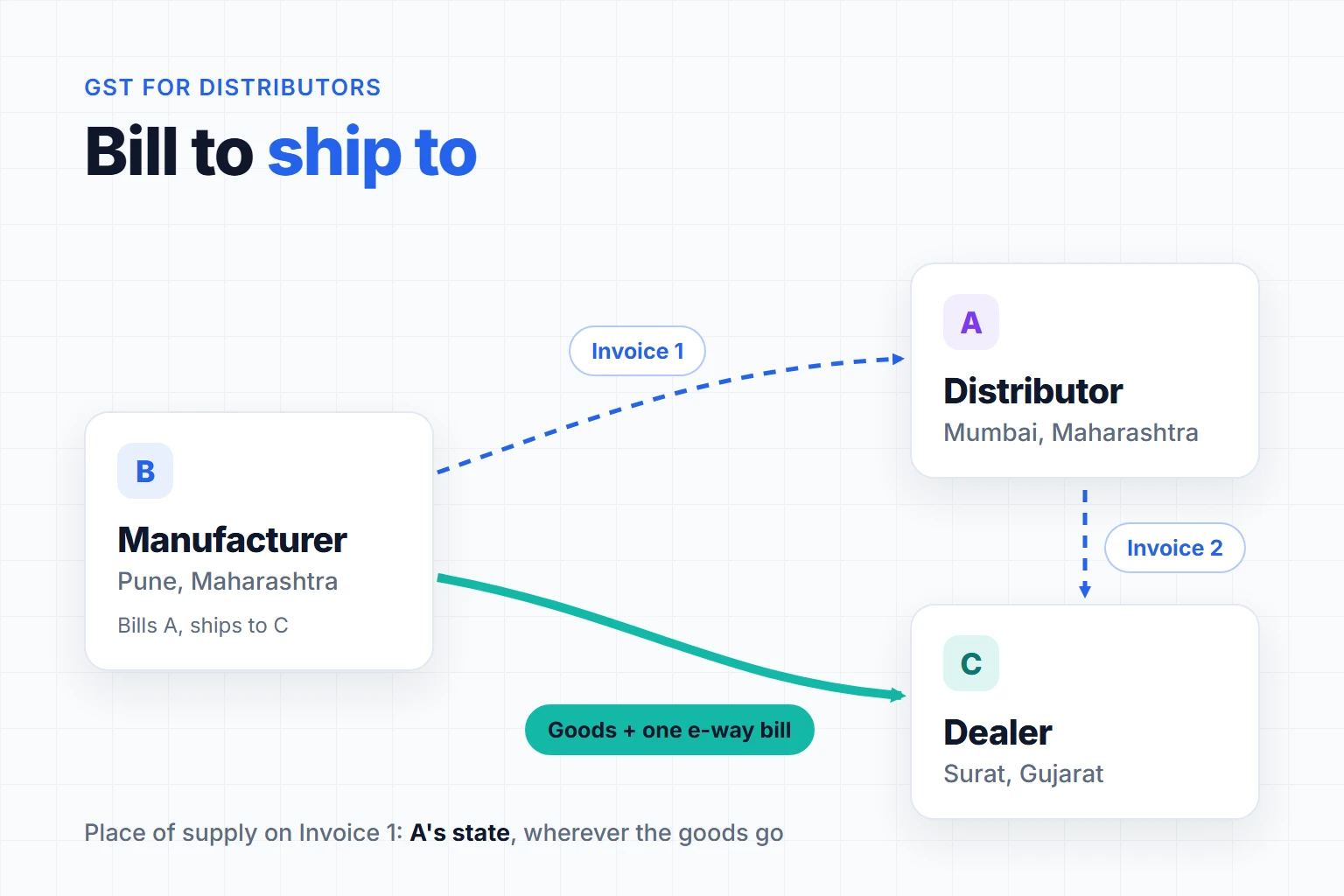
A manufacturer in Pune supplying dealers across Maharashtra, Gujarat, Karnataka and Madhya Pradesh is managing meaningfully different markets under one distribution structure. Field sales teams operate across large territories. Order visibility is intermittent. Pricing discipline is difficult to enforce remotely.
WhatsApp as the default ordering channel
WhatsApp is deeply embedded in Indian business communication. Dealers are comfortable with it. Sales reps use it. Orders flow through it constantly. The challenge is not that dealers use WhatsApp. The challenge is that WhatsApp orders are unstructured, unauditable and invisible to the operations system until someone manually processes them.
GST compliance and invoice accuracy
Since GST implementation, invoice accuracy has become a compliance requirement, not just an operational preference. Orders that flow through informal channels and are manually entered into accounting systems carry a higher error rate and those errors have downstream GST implications. Structured order management reduces this risk.
Credit control across a large dealer base
Indian distribution networks routinely extend credit to dealers. Managing credit limits across fifty or more dealers, enforcing them at the point of order and not after fulfillment, requires system-level control. Sales reps cannot reliably carry this responsibility across a large network.
Categories of Dealer Management Software in India
Not all dealer management software is the same. Understanding the categories helps manufacturers identify which type of platform matches their operational requirements.
Order-taking apps
These are lightweight mobile tools designed for field sales reps to capture orders during dealer visits. They record order data and sync it back to a central system. They improve field order capture but do not address dealer self-service, pricing control or multi-channel ingestion. Useful as a field sales tool, not as dealer commerce infrastructure.
Distribution ERP modules
Larger ERP platforms including SAP, Oracle, Microsoft Dynamics and Indian alternatives like Tally Prime and Busy include distribution modules. These handle internal inventory and accounting workflows well. They are not designed for dealer-facing interactions. Giving dealers direct ERP access is impractical. The gap between the ERP and the dealer ordering workflow remains.
SaaS order management platforms
A growing category of SaaS platforms targets the B2B ordering workflow specifically. These platforms vary significantly in depth. Some focus narrowly on order capture. Others provide a more complete operational layer including dealer portals, pricing control and reporting. Evaluation must go beyond surface features to assess structural completeness.
Dealer commerce infrastructure platforms
The most complete category. These platforms provide the full operational layer between a manufacturer and their dealer network: structured order capture across channels, branded dealer portal, dealer mobile app, role-based pricing, approval workflows, delivery tracking, inventory visibility and ERP or accounting synchronization. This is the category relevant to manufacturers with significant dealer network complexity.
What Indian Manufacturers Should Evaluate
When assessing dealer management software, Indian manufacturers should go beyond demo presentations and evaluate the following dimensions in depth.
Pricing engine depth
Indian distribution networks often have complex pricing structures: base price lists, distributor-specific rates, scheme-based discounts, seasonal pricing, state-level variations and manually approved exceptions. The software must handle this complexity natively and not require workarounds or manual overrides. Ask specifically how the platform manages multiple price lists and dealer-specific exceptions.
Multi-channel order ingestion
Given how embedded WhatsApp is in Indian dealer relationships, a platform that only accepts orders through its own portal will face adoption resistance. The platform should be able to capture orders from WhatsApp, email and field agents and convert them into the same structured workflow as portal orders. This is not a convenience feature. It is an adoption requirement.
Dealer-facing usability
The dealer's team, often a small order desk operation, needs to be able to use the portal and mobile app without significant training. If the system is complex from the dealer's side, adoption will be low and the manufacturer will continue receiving WhatsApp orders regardless of what system they have deployed. Evaluate the dealer experience specifically, not just the manufacturer-side admin interface.
Credit limit enforcement
Credit control is a critical function in Indian distribution. The system should enforce credit limits at the point of order placement and not allow orders to be placed with the issue flagged later. It should also support configurable workflows for credit extension approvals when needed.
GST and accounting integration
For Indian manufacturers, integration with Tally, Busy or other accounting systems used in the Indian market is a practical requirement. Orders should flow into the accounting system with correct GST treatment: IGST for interstate transactions and CGST/SGST for intrastate, without manual re-entry. Verify specifically which accounting platforms the software integrates with and what the integration covers.
ERP optionality
Many Indian manufacturers in the mid-market operate without a full ERP system. Dealer management software should be deployable as a standalone operational layer and not require ERP integration as a precondition. For manufacturers who do run SAP, Oracle or a domestic ERP, integration capability should be available but not mandatory for go-live.
Implementation timeline and support
Indian manufacturing businesses operate in fast-moving commercial environments. A deployment that takes six months is not acceptable. Evaluate what a realistic go-live timeline looks like and what implementation support is provided. Onsite or regional support capability matters for manufacturers outside major metros.
Mobile app quality for dealers
A significant portion of Indian dealers operate primarily on Android mobile devices. The dealer mobile app must be performant on mid-range Android hardware, functional in variable network conditions and genuinely easier to use than sending a WhatsApp message. If it is not, dealers will not use it.
Common Mistakes Indian Manufacturers Make When Buying DMS Software
Buying an order-taking app and expecting dealer commerce infrastructure
Field sales order-taking tools are not dealer management platforms. They solve a narrow problem: capturing orders when a sales rep visits a dealer. They do not address dealer self-service, pricing governance or multi-channel order management. Manufacturers who buy this category expecting full operational control will be disappointed.
Assuming the ERP distribution module is sufficient
ERP distribution modules are designed for internal logistics, not for dealer-facing commerce. Manufacturers who rely on their ERP's distribution module for dealer order management typically end up with a hybrid of ERP screens for internal teams and WhatsApp for dealers. This is not a solved problem.
Choosing on price alone
The cost of dealer order chaos, including pricing errors, disputes, lost orders, operations team overhead and collections friction, significantly exceeds the licensing cost of structured software. Evaluating dealer management software purely on subscription cost misframes the decision. The relevant question is what the operational cost of the current state is.
Underestimating dealer onboarding effort
Deploying software does not automatically mean dealers will use it. Dealer onboarding requires active effort: communicating the change, training order desk staff and making the structured channel genuinely easier than WhatsApp. Manufacturers should plan for dealer onboarding as a project, not assume it will happen organically.
Not auditing pricing complexity before implementation
Most Indian distribution networks have accumulated pricing exceptions, undocumented scheme rates and informal arrangements that are not captured anywhere formally. Before deploying dealer management software, a pricing audit documenting every price list, every dealer tier and every active scheme is essential. Systems built on incomplete pricing data will generate errors from day one.
What Structured Dealer Management Delivers for Indian Manufacturers
Manufacturers who implement structured dealer management software describe a consistent pattern of operational improvement:
Pricing discipline is restored. When pricing is governed at the system level and not through sales rep discretion or WhatsApp negotiation, unauthorized discounts stop. Every dealer pays the rate applicable to their account. Every exception requires an approved workflow.
Order intake becomes manageable. Instead of operations teams processing a stream of WhatsApp orders each morning, orders arrive as structured, validated records. The processing load drops. Error rates fall.
Credit exposure becomes visible. Finance teams can see total outstanding credit across the dealer network in real time. New orders from dealers at their credit limit are flagged or blocked automatically. Collections conversations are grounded in accurate data.
Dispatch and delivery visibility improves. Dealers can track their orders through the portal or mobile app without calling. Field operations can see delivery status in real time. The inbound query volume that occupies operations teams drops substantially.
Accounting reconciliation becomes cleaner. Orders that flow through a structured system arrive in the accounting platform with correct data. GST classification, product codes and dealer details are populated correctly. Finance teams spend less time correcting entries.
Questions to Ask Before Selecting a Platform
Before committing to any dealer management software, Indian manufacturers should get clear answers to the following:
- How does the platform handle dealers who continue placing orders via WhatsApp or email during and after rollout?
- Can it manage multiple price lists simultaneously, with dealer-specific exceptions and scheme pricing?
- Does it enforce credit limits at order placement or only flag issues after the fact?
- Which Indian accounting platforms does it integrate with and what does that integration cover: orders only or invoices and payments as well?
- What does the dealer mobile app look like and can we see it running on a mid-range Android device?
- What is a realistic go-live timeline for a network of our size?
- Can the platform operate without ERP integration initially and add it later?
- What does the implementation and onboarding support process look like?
- Is there a reference customer we can speak with who operates a similar distribution network?
A Framework for Evaluating Vendors
Before contacting vendors, align internally on the problem being solved: how dealers currently place orders, the error rate in order processing today, how many price lists and informal exceptions exist, how credit exposure is tracked, and which existing systems (ERP, accounting, inventory) need to connect. The answers define the evaluation criteria more usefully than any vendor demo.
Once demos start, three questions decide the shortlist. Does the platform solve the structural problem, not just the surface one? Will dealers actually use it, given that the best admin console is worthless if the dealer network keeps calling instead of ordering through it? And can it be deployed without months of disruption? Deployment timeline is a capability, not a commercial detail: infrastructure-grade platforms run a pilot with a small dealer group first, validate the workflow, then expand, rather than attempting a full-network rollout on day one.
Summary
The Indian dealer management software market in 2026 spans a wide range of platforms, from narrow order-taking tools to full-stack dealer commerce infrastructure. Choosing the right category matters as much as choosing the right vendor.
For manufacturers managing fifty or more active dealers across a distribution network, the requirement is structured dealer commerce infrastructure: multi-channel order capture, role-based pricing control, dealer portal and mobile app, credit enforcement, delivery tracking and accounting integration. Lightweight tools in this category solve surface problems without addressing the structural issues that create operational cost.
The right platform is one that dealers will actually use, that enforces pricing discipline without sales rep intervention, that connects to existing accounting infrastructure and that can go live in weeks not quarters.
Dealer order chaos is not inevitable. It is the result of scaling a distribution network without scaling the operational infrastructure that governs it.
ZunderFlow is a dealer commerce and operations infrastructure platform built for Indian manufacturers and distributors managing active dealer networks. It provides structured ordering workflows, branded dealer portals and mobile apps, multi-channel order capture including WhatsApp and email ingestion, role-based pricing control, credit limit enforcement and integration with Indian accounting platforms including Tally. Deployments go live in days, not months.