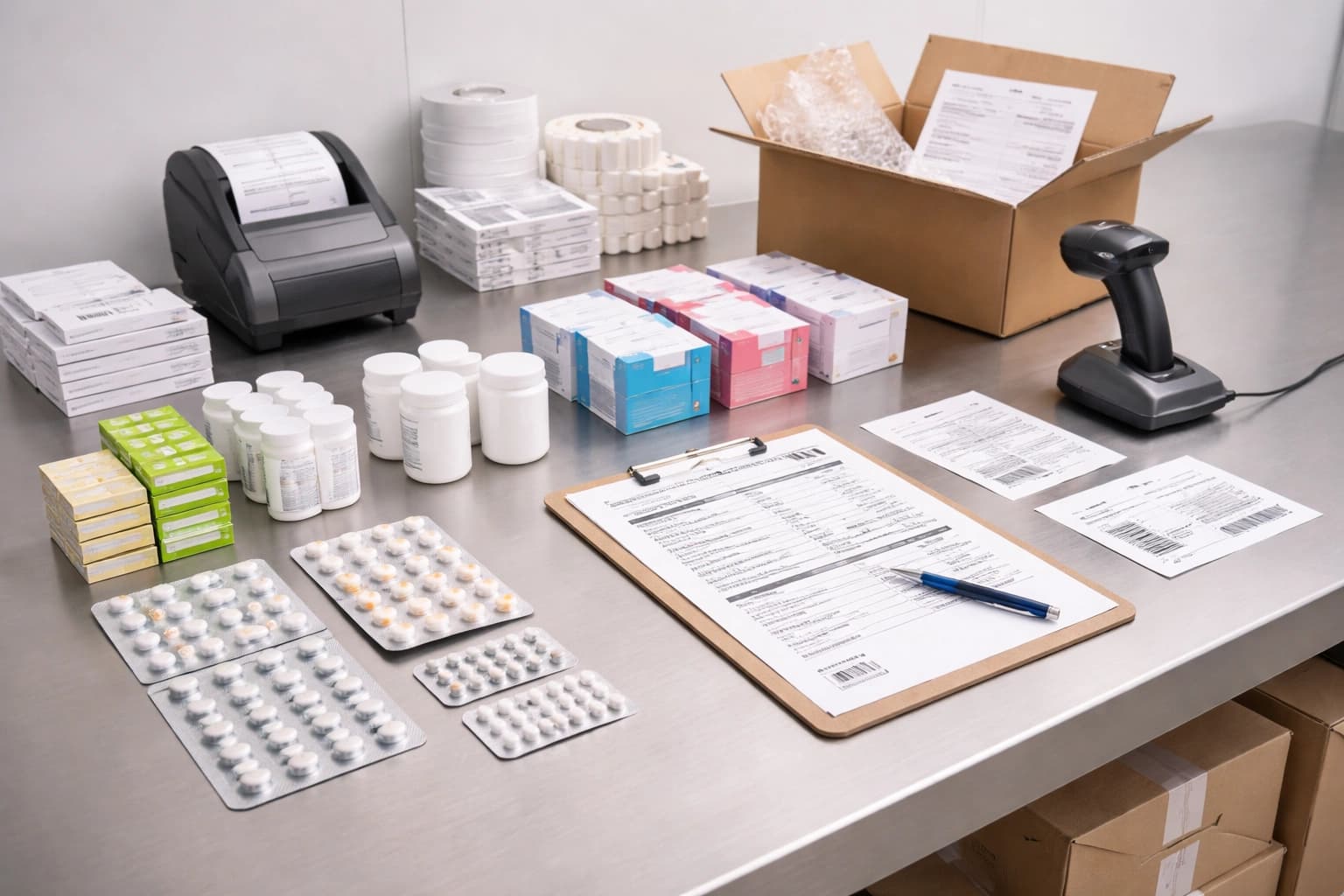
Pharmaceutical distribution operates under a compliance burden that most other manufacturing sectors do not face. Every order placed by a stockist or dealer is not just a commercial transaction - it is a regulated event. The product being ordered is a licensed drug. The entity ordering it must be authorised to hold and dispense it. The quantity ordered, the batch it is fulfilled from and the chain of custody from manufacturer to end point must all be traceable on demand.
Most pharmaceutical manufacturers understand this in principle. The practical gap appears at order intake. Compliance frameworks are designed around documentation, audits and reporting. They assume that a structured order record exists to audit. When dealer orders are arriving through WhatsApp, phone calls and informal channels, that assumption fails before the compliance process begins.
The structural problem is not that pharmaceutical manufacturers lack compliance intent. It is that the order intake layer - where dealers place orders and those orders enter the manufacturer's operations - is often informal enough that compliance cannot be reliably applied to it. This piece covers what compliant dealer order infrastructure requires and why it has to be built into how orders are captured, not applied to them afterwards.
Why Compliance Cannot Be Retrofitted to Informal Order Intake
The compliance requirement in pharmaceutical distribution is not satisfied by documenting what happened after an order was processed. It requires that the order record itself - from the moment it was placed - contains the information that compliance and traceability depend on.
Consider what a WhatsApp order from a stockist typically contains: a product name, sometimes a quantity and occasionally a reference to a previous order. It does not contain the stockist's licence number, the authorised signatory placing the order, confirmation that the product requested is within the stockist's permitted product scope or a timestamp that qualifies as a formal record under regulatory scrutiny.
The operations team processes the order. The ERP records the dispatch. The invoice is generated. At each stage, the underlying order record - the WhatsApp message - is informal, unstructured and not part of any auditable system. If a regulator requires a trace of every order placed for a specific product batch in a specific territory over a defined period, reconstructing that trace from WhatsApp threads and ERP entries that were manually keyed from those threads is not a compliance exercise. It is a forensic reconstruction, and it will not always produce reliable results.
Compliance in pharmaceutical distribution has to start at order intake. The order record that enters the system has to carry the information that compliance requires, captured at the point the order is placed, not assembled after the fact.
What Compliant Dealer Order Infrastructure Requires
Building compliant order intake for a pharmaceutical dealer network is not primarily a regulatory technology exercise. It is an operational infrastructure exercise with compliance requirements built in as structural constraints. The capabilities required are specific.
Authenticated dealer access with licence verification
Every dealer or stockist placing an order must do so through an authenticated account that is linked to their regulatory credentials. The system must know, at the point of order placement, that the entity placing the order is a licensed distributor or stockist authorised to purchase the products being ordered.
This means dealer accounts are not generic login credentials. They carry the licence number, licence expiry date and authorised product scope for that entity. An order placed by an account whose licence has expired is flagged before it enters the fulfillment queue, not discovered during an audit months later. An order for a product category outside the stockist's authorised scope is blocked at placement, not processed and investigated retrospectively.
Order-level audit trail from placement through delivery
The audit trail for a pharmaceutical order must cover every event from placement to delivery confirmation. Order placed, order reviewed, order approved, dispatched, batch assigned, out for delivery, delivered. Each event must be timestamped and attributed to the user or system that triggered it.
This trail must be structured and queryable. A regulatory enquiry that asks for every order dispatched from a specific warehouse for a specific product code between two dates must produce a complete, accurate list in minutes. The audit trail must also be immutable: events cannot be edited or deleted after they are recorded, only appended to.
Batch-level traceability at order fulfillment
Pharmaceutical distribution compliance requires that the batch number of every product dispatched against every order is recorded against that order. If a batch recall is issued, the manufacturer must be able to identify every order that was fulfilled from that batch, every dealer who received stock from it and the current location of that stock in the distribution network.
This requires that batch assignment happens at dispatch, is recorded in the order record and is linked to the dealer account that received the stock. It cannot be a separate record that requires manual cross- referencing with the order system. Batch and order have to be connected in the same data structure.
Role-based access controls across the dealer network
Not every user in a dealer's organisation should have the same access to the ordering system. The order desk staff who place routine orders should not have access to credit limit information or pricing tier configuration. The dealer's finance contact should be able to view account statements without accessing the order placement workflow.
Role-based access controls ensure that each user in the dealer organisation sees and can do only what their role requires. This is not just an operational convenience - it is an access governance requirement that reduces the risk of unauthorised orders, pricing manipulation and account data exposure.
Pricing control with approval workflows for exceptions
Pharmaceutical pricing in India operates within a regulated framework for scheduled drugs and a structured commercial framework for non-scheduled products. The dealer order system must apply the correct pricing automatically at order placement and must not allow pricing to be overridden at the order desk level without a documented approval workflow.
Any pricing exception - a discount, a scheme rate, a negotiated adjustment - must be recorded in the audit trail with the approving authority identified. Unrecorded pricing exceptions are a compliance risk and a financial governance gap simultaneously.
The Multi-Channel Problem in Pharmaceutical Distribution
Pharmaceutical stockists place orders through multiple channels in practice. The dealer portal is the structured channel. WhatsApp, phone calls and field medical representative visits are the informal channels that persist alongside it because they are faster and more familiar.
The compliance risk in a multi-channel environment is that the informal channels do not produce compliant order records. An order placed by a stockist via WhatsApp and manually entered into the system by the operations team carries a different compliance status than an order placed by the stockist directly through an authenticated portal. The manually entered order has no authenticated origination, no confirmed licence check at placement and no direct link between the ordering entity and the order record.
The operational answer is not to eliminate informal channels by force - that approach produces resistance and drives ordering further underground. It is to build a structured intake layer that captures informal channel orders into the compliant system at the point of entry, with the same structured fields and the same audit event created, so that every order in the system - regardless of how it originated - carries a consistent compliance record.
Orders that arrive through WhatsApp or by phone should be entered into the system by the operations team against the stockist's authenticated account, with the channel of origin recorded. The stockist account provides the licence verification. The system provides the audit trail. The channel of origin is documented for reporting. This is structurally different from a manually keyed ERP entry with no account linkage and no compliance fields populated.
Delivery Traceability and the Last-Mile Compliance Gap
Batch-level traceability that ends at dispatch is not full traceability. It establishes which batch was sent but not that it was received by the licensed entity it was sent to. For pharmaceutical distribution compliance, delivery confirmation - confirmed receipt by the authorised dealer or stockist - is part of the chain of custody record.
This requires that the delivery workflow is integrated with the order management system. When a rider or logistics partner delivers an order, the delivery event is recorded against the order record in the system. Proof of delivery - a signature, a confirmation scan or a digital acknowledgment - is attached to the order at the point of delivery and stored as part of the permanent order record.
The dealer or stockist can see delivery confirmation in their portal. The manufacturer has a complete chain of custody from order placement through batch assignment through confirmed delivery. If a discrepancy arises - a stockist claims they did not receive an order, or received incorrect quantities - the delivery record provides the reference point for resolution.
Manufacturers who rely on rider confirmation via WhatsApp message and manual ERP update have a delivery record. They do not have a delivery record that is structurally linked to the order, the batch and the authorised recipient in a single queryable system. That gap is the last-mile compliance gap and it is consistently underestimated.
What Regulatory Scrutiny Actually Requires
Pharmaceutical distribution in India is subject to oversight from the Central Drugs Standard Control Organisation and state drug authorities. Inspections and audits require manufacturers to produce records that demonstrate controlled distribution: who ordered what, from which licensed entity, fulfilled from which batch, delivered to which location and confirmed by whom.
The practical test of a compliant order infrastructure is not whether it can produce these records in theory. It is whether it can produce them on demand, completely, accurately and within the time frame that a regulatory request typically allows.
A manufacturer whose dealer orders are structured, authenticated and linked to batch and delivery records in a unified system can answer a regulatory query by running a filtered report. A manufacturer whose order records are distributed across WhatsApp threads, manually keyed ERP entries and separate delivery logs cannot produce the same answer with the same confidence or the same speed.
The compliance infrastructure is also the operational infrastructure. There is no separate compliance record to maintain. The order system that governs daily dealer operations is the same system that produces the regulatory trace when it is required. That is the design principle that compliant pharmaceutical distribution infrastructure should be built around.
Implementation Considerations for Pharmaceutical Manufacturers
Pharmaceutical manufacturers deploying structured dealer order infrastructure face specific implementation considerations that differ from general manufacturing deployments.
Dealer licence data management. The system must hold current licence information for every active dealer account, with expiry date tracking and automated alerts when licences approach renewal. Maintaining this data requires a structured onboarding process for new dealer accounts and a periodic verification cycle for existing ones. It cannot be managed through a manual spreadsheet alongside a live order system.
Scheduled drug controls. Products under price control or subject to quantity restrictions require that the ordering system enforces these constraints at placement. The pricing engine must carry awareness of which products are scheduled and apply the relevant controls automatically, with any permitted exception documented through a formal approval workflow.
Phased dealer onboarding with compliance validation. Rolling out a structured order system across a pharmaceutical dealer network should begin with a pilot cohort where the compliance fields, licence checks and audit trail are validated before the full network is onboarded. Problems in the compliance configuration of a pilot of fifteen dealers are correctable. The same problems discovered after onboarding two hundred dealers simultaneously carry significantly higher remediation cost.
Integration with accounting and ERP. Compliant order records that do not flow into the accounting system create a reconciliation gap between the order system and the financial record. Integration between the dealer order infrastructure and the manufacturer's accounting or ERP platform ensures that every order that enters the structured system produces the corresponding financial record without manual transfer.
Summary
Pharmaceutical distribution compliance is not a documentation exercise that follows order processing. It is a structural requirement that must be embedded in how orders are captured from the moment a dealer places one.
The infrastructure requirements are specific: authenticated dealer access with licence verification, order-level audit trail from placement through delivery, batch-level traceability linked to each order, role-based access controls and a pricing engine that enforces regulated and commercial pricing with documented exceptions.
A manufacturer who builds this infrastructure builds it once and operates it as the daily backbone of dealer commerce. The compliance record is a natural output of a system that is already governing how orders are placed, priced, fulfilled and delivered. It does not require a separate compliance layer. It requires an order infrastructure that is structured enough that compliance is already present in every transaction.